Testosterone optimization in women
Female testosterone is a primary, not adjunctive, intervention — the labial cream route, the numeric Free T target, the DHT-preserve rationale, and why the female protocol diverges sharply from male TRT.
Learning objectives
After completing this module, you will be able to:
- Differentiate female testosterone protocols from male TRT in route, dose, target, and aromatization expectations.
- Apply the Nimbus labial-cream primary protocol — compounded testosterone 20 mg/mL, 1/4 mL (5 mg) QHS — and articulate the local-DHT rationale for that route.
- Interpret cross-vendor Free T targets in women (Quest 6–8 pg/mL; LabCorp 3–4 pg/mL) and reconcile them with Total T (200–300 ng/dL).
- Evaluate alternate routes — 40 mg/mL cream step-up, sublingual, oral USP, subcutaneous injection, and pellets — including the Nimbus caution against high-dose pellet protocols in women.
- Construct a workup for low libido, fatigue, and HSDD in a postmenopausal woman that initiates compounded testosterone with appropriate off-label documentation.
- Identify the female-specific contraindications and explain why 5-alpha-reductase inhibitors are excluded from the standing protocol.
Disclosures & accreditation statement
Activity type
Internal Provider Education
Faculty & planners
- Dr. Jobby John, PharmD, FACA (author) — Founder & CEO, Nimbus Healthcare (employer); Inventor of IntelliHealth Clinical Decision Intelligence Platform.
- Dr. Jobby John, PharmD, FACA (reviewer) — Founder & CEO, Nimbus Healthcare (employer); primary clinical reviewer.
- Dr. Richard Harris, MD, PharmD, MBA (reviewer) — Secondary clinical reviewer. Relevant financial relationships: [to be disclosed].
- Dr. Tracy Neal, MD (reviewer) — Tertiary clinical reviewer — women's health content. Relevant financial relationships: [to be disclosed].
Off-label / unapproved use
This activity discusses off-label or unapproved use of: Compounded testosterone cream (20 mg/mL and 40 mg/mL) for women — no FDA-approved female testosterone product exists in the US, Labial / vaginal-vestibule application route for compounded testosterone cream — off-label vs. any labeled topical men's testosterone product, Compounded sublingual testosterone tablets 2–6 mg QD–BID for women, Compounded oral USP testosterone 30–50 mg QAM for women (methyltestosterone is contraindicated and not used), Off-label subcutaneous testosterone injection 6–10 mg twice weekly for women, Off-label compounded testosterone pellets ~2 mg/kg (range 50–200 mg) every 3–6 months in women, Spironolactone up to 100 mg BID for androgenic side-effect management in women (on-label for hyperaldosteronism), Dutasteride 0.5 mg twice weekly as last-line for androgenic alopecia in women on testosterone, Topical testosterone for genitourinary syndrome of menopause (GSM).
Commercial support
None.
All relevant financial relationships have been identified, reviewed, and mitigated per ACCME Standards for Integrity and Independence.
The premise
Female testosterone optimization is the most underprescribed, most stigmatized intervention in postmenopausal medicine. The mainstream framing treats androgen replacement in women as adjunctive — something you reach for after estrogen and progesterone are dialed in, and only if a patient is willing to accept the label "off-label." The Nimbus position is the opposite. In a symptomatic postmenopausal woman with low Free T, testosterone is a primary intervention — sitting in the same first-line tier as estradiol and progesterone, with its own optimal target, its own preferred route, and its own contraindication set.
This module trains the prescriber and the pharmacist to (a) confirm symptoms plus a Free T below optimal, (b) initiate the compounded labial cream as the default route, (c) interpret the numeric Free T target across vendors, (d) preserve the patient's DHT signal rather than block it, and (e) document the off-label use carefully. The female protocol diverges sharply from male TRT — in route, in dose, in target, and in what we expect (or do not expect) the molecule to do at the receptor.
Pre-test
Check yourself
An HRT-treated postmenopausal woman is on the Nimbus testosterone protocol. The optimal Free T target on a Quest LC/MS/MS assay is approximately:
Why testosterone is primary, not adjunctive, in female HRT
Image
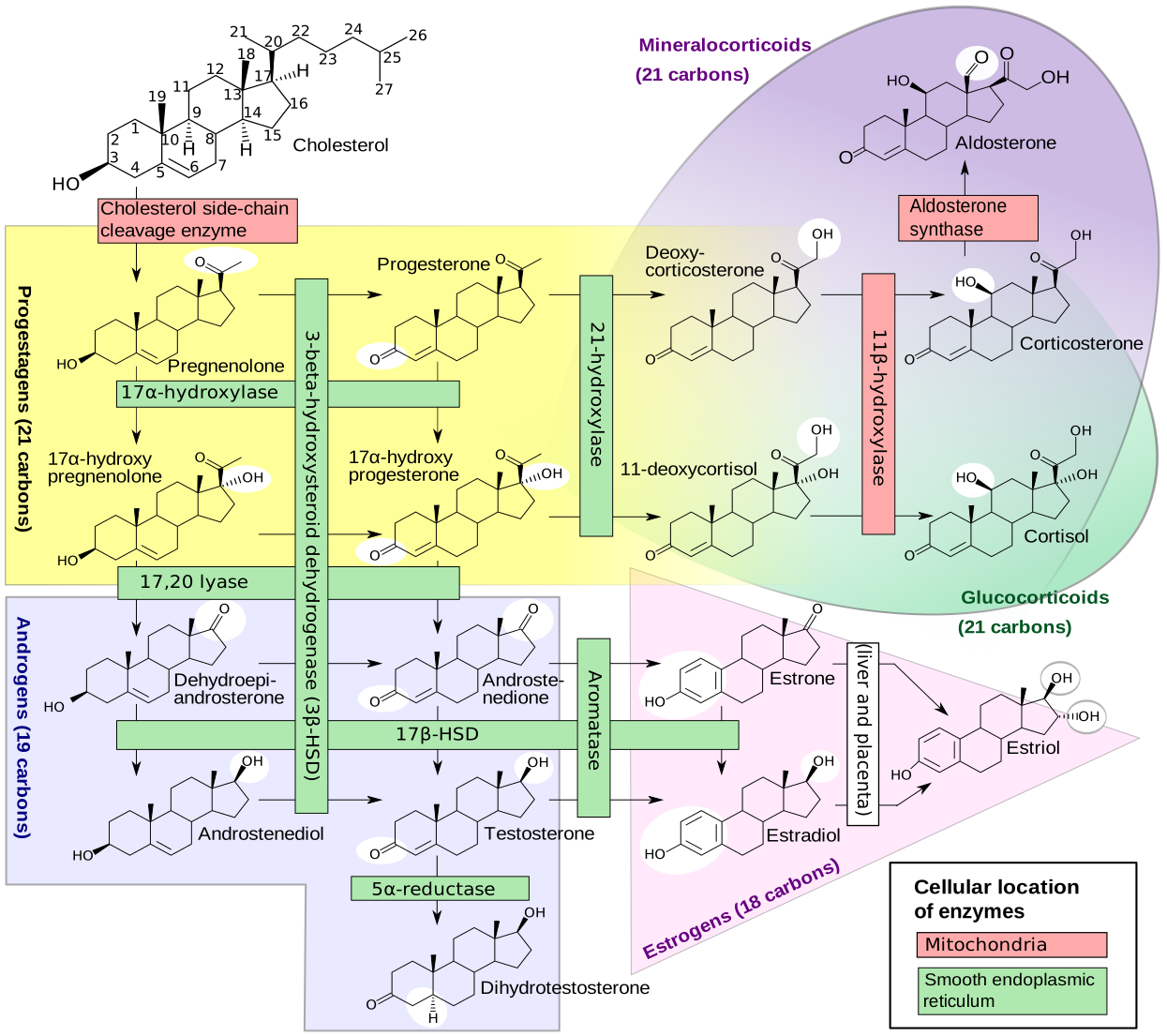
DHEA is the upstream precursor; A4 (androstenedione) bridges; testosterone yields both DHT (5α-reduction) and estradiol (aromatization). The female protocol preserves DHT and accepts no AI co-prescription because mood, libido, and bone all need 5α-DHT — and aromatization in women on physiologic-dose T cream is negligible.
Credit·Mikael Häggström, CC-0 (public domain dedication) — Wikimedia Commons
Female testosterone has been treated as an afterthought for two reasons that do not survive scrutiny. First, there is no FDA-approved female testosterone product in the US — every preparation a postmenopausal woman might use is compounded, every dose is off-label, and the prescribing culture has internalized the absence of an approved product as evidence the intervention is unvalidated. Second, the fear that women on testosterone will be "masculinized" has shaped guidelines more than the underlying physiology has.
Both arguments collapse under the data. The 2019 global consensus statement on testosterone therapy in women[Davis-2019-consensus] endorsed testosterone for postmenopausal HSDD and acknowledged the absence of an FDA-approved product as a regulatory gap, not a clinical one. The downstream clinical reality — fatigue, low libido, blunted sexual response, low muscle mass, mood — maps to androgen deficiency in postmenopausal women with the same internal consistency that low E2 maps to vasomotor symptoms.
The Nimbus framing: if you would not withhold estradiol from a symptomatic postmenopausal woman because there is no perfect female-dosing trial, you do not withhold testosterone for the same reason.[nimbus-policy-03-testosterone-women]
The labial cream protocol — 20 mg/mL, 1/4 mL QHS — and why this route
Schematic
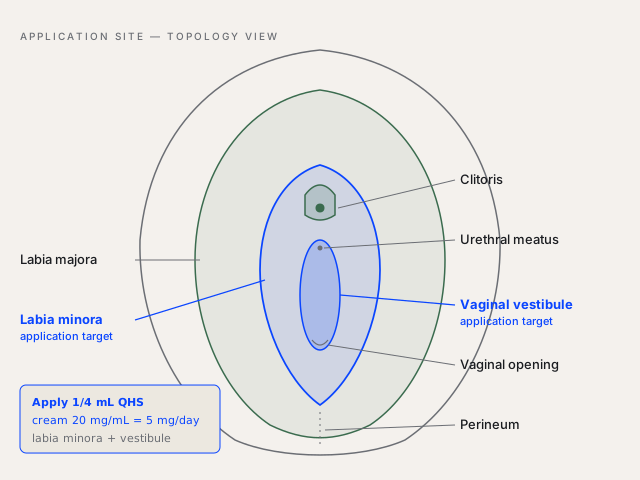
Labial application targets the vestibular tissue, where local absorption is maximal and systemic exposure on the 1/4 mL cream dose stays within the female physiologic Free T target.
Source·BHRT clinical protocol — Nimbus module 03
The Nimbus default initiation is a compounded testosterone cream at 20 mg/mL, applied 1/4 mL (5 mg) to the labia / vaginal vestibule QHS. This is the preferred route — not the upper inner arm, not sublingual, not injection, not pellets — for three reasons that are mechanistic, not stylistic.
- Systemic exposure. Vestibular skin absorbs testosterone systemically with pharmacokinetics comparable to other thin-skinned application sites.
- Local DHT. 5-alpha-reductase converts a fraction of locally applied testosterone to DHT in the labial and clitoral tissue. DHT is the dominant androgen at the clitoral androgen receptor and is required for the clitoral engorgement and orgasmic response that motivate the therapy in the first place.
- GSM overlap. Topical testosterone applied vaginally improves vaginal pH, vaginal health score, and lactobacilli population on a 12-week timescale in the Fernandes 2016 RCT[Fernandes-2016-vaginalT] — comparable to topical estradiol on those endpoints, without endometrial change.
The labial route therefore covers libido, orgasmic response, GSM, and systemic levels in a single application. No other route delivers all four.
Alternates — 40 mg/mL cream, micro-dose click, pellets
A subset of patients cannot or will not use the labial route. The alternates, in approximate order of how often Nimbus reaches for them:
- Step-up cream — 20 mg/mL 1/2 mL QHS or 40 mg/mL 1/4 mL QHS (each delivering ~10 mg/day) when 5 mg/day has not produced symptom or Free T response at 8–12 weeks.
- Upper inner-arm topical, 1/4 mL daily — systemic only; loses the local DHT benefit. Reasonable when labial application is declined.
- Sublingual tablet 2–6 mg QD–BID for patients who prefer an oral-route micro-dose.
- Oral compounded USP testosterone 30–50 mg QAM — acceptable when topical and sublingual routes fail. Never methyltestosterone; the alkylated congener is hepatotoxic and is not used at Nimbus in either sex.
- Subcutaneous injection 6–10 mg twice weekly — off-label; reserved for patients in whom topical absorption is inadequate.
- Pellets ~2 mg/kg (range 50–200 mg) every 3–6 months — off-label and used with caution. Supraphysiologic peaks are common when pellet dose pushes Free T above the 6–8 pg/mL Quest band; the Nimbus position is that pellets in women are an exception, not a default. TODO(citation): Nimbus pellet-titration policy (internal).
Numeric targets — Quest 6–8 pg/mL vs. LabCorp 3–4 pg/mL Free T
The cross-vendor mismatch is the single most common point of confusion when reading a female testosterone result. Quest and LabCorp use different Free T assay methodologies; the optimal band on each vendor is approximately:
- Quest: Free T 6–8 pg/mL.
- LabCorp: Free T 3–4 pg/mL.
- Total T (either vendor): 200–300 ng/dL — supportive, but secondary to Free T when the two disagree.[nimbus-policy-03-testosterone-women]
The LabConverter widget below applies the empirical Quest↔LabCorp factor. Authors and reviewers should treat the converter output as a sanity check — a value at the edge of the optimal band on one vendor will sit at the corresponding edge on the other.
Analyte
Free Testosterone (women) (pg/mL)
- Quest (LC/MS/MS)0.1–6.4 pg/mL8
Nimbus optimal: 6–8 pg/mL
- LabCorp (equilibrium dialysis)0.1–4.2 pg/mL4
Nimbus optimal: 3–4 pg/mL
Figure
Numeric Free T target by vendor. The female protocol aims for the upper end of the female physiologic range; doses that push above 8 pg/mL on Quest produce androgenic side effects without commensurate symptom benefit.
Source·Nimbus clinical policy + BHRT syllabus; vendor target methodology — see docs/anti-gap/03-testosterone-women.md for citation TODOs
Interactive · Quest ↔ LabCorp converter
Progesterone (postmeno)
Equivalent on quest
10.50 ng/mL
Optimal target · Quest >= 10 · LabCorp >= 3
Bioidentical progesterone. Do not test in pre/peri/PCOS — treat by symptoms.
A note on SHBG: women on oral E2, oral contraceptives, or the vaginal ring frequently run elevated SHBG, which depresses bioavailable T and surfaces or worsens deficiency. SHBG is useful to interpret a discrepancy between Total T (which may look adequate) and Free T (which is the symptom-correlated metric).
DHT preservation — why 5-alpha-reductase inhibitors are blocked in this protocol
In men, DHT is the dominant androgen at the prostate androgen receptor and the driver of the benign prostatic hyperplasia / androgenic alopecia complex that 5-alpha-reductase inhibitors (finasteride, dutasteride) are designed to suppress. In women, DHT is the dominant androgen at the clitoral androgen receptor. The clinical effects we want from female testosterone — clitoral engorgement, orgasmic response, GSM benefit — are downstream of DHT, not of testosterone itself.
The Nimbus standing protocol therefore excludes 5-alpha-reductase inhibitors in women on testosterone optimization. Co-prescribing finasteride or dutasteride strips the local DHT signal the labial route was specifically chosen to generate. If a patient on female testosterone develops scalp thinning, the workup is:
- Confirm ferritin ≥80 ng/mL (low iron is a frequent and reversible driver).
- Confirm thyroid is optimized (FT3 in the optimal band).
- Trial topical minoxidil 5% (or oral minoxidil 1.25 mg/day) as the first-line dermatologic intervention.
- Only after those steps fail, and with explicit informed consent regarding post-finasteride syndrome, consider dutasteride 0.5 mg twice weekly as last-line — and counsel the patient that this option is reserved for those committed to remaining on testosterone long-term.
Spironolactone (up to 100 mg BID) is acceptable for confirmed androgenic acne or hirsutism in women; it is not a substitute for dose reduction or for the ferritin/thyroid workup.
Female testosterone does not aromatize meaningfully — implications for E2 expectations
In men, a fraction of administered testosterone aromatizes to estradiol, and the rising E2 is sometimes the dose-limiting issue. In women, exogenous testosterone at physiologic-range doses does not meaningfully aromatize to E2.[nimbus-policy-03-testosterone-women] This has two practical consequences.
- Do not gate female testosterone titration on E2 trends. A rising or falling E2 in a woman on labial cream is being driven by her estradiol therapy (or its absence), not by her testosterone.
- Do not deploy aromatase inhibitors as part of female testosterone management. The mechanism that justifies aromatase inhibition in a small number of male TRT cases does not apply.
Symptom monitoring — libido, energy, mood, body composition
The Nimbus reassessment at 8–12 weeks is symptom-driven first and lab-driven second. The domains we expect to move:
- Libido and HSDD. Spontaneous desire and responsive arousal both improve; this is typically the earliest and most patient-noticed change.
- Orgasmic response. Clitoral sensitivity and orgasmic intensity improve on the labial route specifically — this is the DHT-mediated signal and is a reason to prefer the labial route over systemic-only alternates.
- Energy and mood. Reduction in fatigue and anxiety; mood-stabilizing effect reported across cohort literature.
- Body composition. Lean mass and strength improve on a slower timescale (months, not weeks); this is the rationale for not declaring the protocol a failure at the 8-week mark on body-composition grounds alone.
Lab confirmation: Total T plus Free T, drawn 4–5 hours after the morning medications, with the labial cream applied the previous evening.
Safety blocks — pregnancy/lactation, breast cancer, etc.
The female testosterone protocol is gated by the following blocks, applied at intake and re-confirmed at every reassessment:
- Active or history of hormone-sensitive cancer (breast, endometrial, ovarian). Oncology clearance required.
- Pregnancy or trying to conceive. Testosterone is teratogenic to the female fetus; this is an absolute block.
- Breastfeeding. Absolute block for the lactation window.
- Severe hepatic impairment. Caution with oral USP testosterone; topical routes are preferred when oral cannot be avoided.
- Severe baseline acne, hirsutism, or androgenic alopecia. Relative blocks — counsel, optimize ferritin and thyroid first, and start at the lower end of the dose range.
A patient on a combined OCP, ring, or Depo provera frequently needs testosterone because the contraceptive raises SHBG and lowers bioavailable T; the contraceptive is not a contraindication to female testosterone, but it does change the SHBG interpretation.
Mid-module checkpoint
Check yourself
A 52-year-old postmenopausal woman on oral E2 plus oral micronized progesterone reports persistent low libido and fatigue. Total T 145 ng/dL, Free T 2.5 pg/mL on Quest. Which initiation does Nimbus protocol specify?
Role-specific guidance
Preview · showing both tracks
For prescribers
Initiation workflow.
- Confirm symptoms (HSDD, low libido, fatigue, blunted orgasmic response, low muscle mass) plus a Free T below optimal (≤4 pg/mL on Quest, ≤2 pg/mL on LabCorp).
- Screen the absolute blocks: pregnancy / trying to conceive, lactation, active or history of hormone-sensitive cancer.
- Document off-label use, route, dose, and the patient's consent in the chart.
- Prescribe compounded testosterone cream 20 mg/mL, 1/4 mL (5 mg) to labia / vaginal vestibule QHS.
- Counsel on application: clean hands, after evening hygiene, before bedtime. The site is the inner labia and the vaginal vestibule; partner contact is not a meaningful transfer concern at this dose.
Titration cadence.
- Reassess at 8–12 weeks: symptoms, Total T, Free T (blood drawn 4–5 hours after AM hormones; evening dose taken the night before).
- If Free T is below target and symptoms persist, step up to 20 mg/mL 1/2 mL QHS (10 mg/day) or 40 mg/mL 1/4 mL QHS (10 mg/day).
- Once at symptom-optimal Free T, maintenance is the lowest dose that holds symptom resolution within the 6–8 pg/mL Quest band.
Adverse-effect management.
- Mild acne / oily skin or new hirsutism: reduce dose 25–50% or switch to every-other-day dosing.
- Persistent androgenic AE despite dose reduction: add spironolactone up to 100 mg BID.
- Scalp thinning: ferritin and thyroid workup before any 5-alpha-RI; topical minoxidil 5% first; dutasteride only as last-line with informed consent.
- Voice deepening or clitoral enlargement that bothers the patient: reduce dose; voice changes are rare at physiologic doses.
For pharmacists
Compounding considerations.
- Default formulation: testosterone 20 mg/mL in a cream vehicle suitable for labial / vestibular application — typically an anhydrous or low-irritation aqueous cream base. The 40 mg/mL step-up uses the same base.
- Vehicle choice matters at the application site: avoid bases with propylene glycol in patients who report vestibular burning. Confirm USP testosterone (micronized) — methyltestosterone is not used.
- Calibrated 1-mL oral syringe is the dispensing measure; 1/4 mL graduation is the per-dose volume.
- Beyond-use dating per USP <795> for the chosen base; assign and label.
Application counseling at dispense.
- Clean, dry hands; evening hygiene complete.
- Express 1/4 mL onto fingertip; apply along inner labia and vaginal vestibule. Do not insert deep into the vaginal canal.
- Wash hands after application. Avoid towel transfer to bedding for 30 minutes.
- Apply the evening before any morning lab draw so that the 4–5 hour post-dose window is captured.
Companion-medication watch.
- Flag concurrent finasteride or dutasteride prescriptions to the prescriber — Nimbus protocol excludes 5-alpha-reductase inhibitors in women on testosterone optimization.
- Flag concurrent combined OCP / ring / Depo — SHBG-elevating regimens commonly worsen bioavailable T and may explain a persistent symptom picture despite "normal" Total T.
Cheat sheet
Labial cream — default
20 mg/mL1/4 mL QHS
5 mg/day to labia / vaginal vestibule. Reassess at 8–12 weeks.
Free T target — Quest
6–8pg/mL
Primary gating metric in postmenopausal women on therapy.
Free T target — LabCorp
3–4pg/mL
Different assay; same clinical optimal band, different number.
Total T target
200–300ng/dL
Same units on Quest and LabCorp; supportive metric.
5-alpha-RI rule
Excluded
Finasteride / dutasteride strip clitoral DHT and are not co-prescribed with female T.
Aromatization in women
Negligible
Do not gate female T titration on E2. Aromatase inhibitors not used.
Pellet caution
Exception
High-dose pellets often push Free T above the Quest 6–8 pg/mL band — not a Nimbus default.
Absolute blocks
3
Active or hx hormone-sensitive cancer; pregnancy / trying to conceive; lactation.
Step-up cream
10 mg/day
20 mg/mL 1/2 mL QHS OR 40 mg/mL 1/4 mL QHS after 8–12 weeks if needed.
Post-test
Check yourself
A patient has been on compounded testosterone cream 20 mg/mL, 1/4 mL QHS to labia for 5 months. She reports excellent libido and mood. At month 4 she developed mild diffuse scalp thinning. Ferritin is 45 ng/mL, FT3 is 3.2 pg/mL, TSH 2.8 mIU/L. A friend told her she should add finasteride. The Nimbus next step is: