Foundations of Hormone Replacement Therapy
The framing every Nimbus prescriber and pharmacist starts with: endocrine physiology, lab interpretation, reading the literature, and how Nimbus departs from mainstream conventions — with the reasoning.
Learning objectives
After completing this module, you will be able to:
- Differentiate bioidentical hormones from synthetic analogs and explain the clinical implications.
- Interpret the major HRT landmark trials (WHI, DOPS, KEEPS, ELITE, TRAVERSE) and identify their methodological strengths and limitations.
- Compare Quest and LabCorp reference ranges for the core hormones used in Nimbus protocols.
- Articulate the Nimbus clinical lens — when we treat to optimal vs. normal, and why.
- Apply the universal safety blocks that gate any HRT initiation.
Disclosures & accreditation statement
Activity type
Internal Provider Education
Faculty & planners
- Dr. Jobby John, PharmD, FACA (author) — Founder & CEO, Nimbus Healthcare (employer); Inventor of IntelliHealth Clinical Decision Intelligence Platform.
- Dr. Jobby John, PharmD, FACA (reviewer) — Founder & CEO, Nimbus Healthcare (employer); primary clinical reviewer.
- Dr. Richard Harris, MD, PharmD, MBA (reviewer) — Secondary clinical reviewer. Relevant financial relationships: [to be disclosed].
- Dr. Tracy Neal, MD (reviewer) — Tertiary clinical reviewer — women's health content. Relevant financial relationships: [to be disclosed].
Off-label / unapproved use
This activity discusses off-label or unapproved use of: Compounded bioidentical hormones, DTE (desiccated thyroid extract) use beyond labeled indications.
Commercial support
None.
All relevant financial relationships have been identified, reviewed, and mitigated per ACCME Standards for Integrity and Independence.
The premise
Hormone replacement therapy sits in a long-running argument between two camps: one that extrapolates the WHI findings to every form of hormone therapy, and one that distinguishes bioidentical hormones from the synthetic analogs WHI actually studied. Nimbus practices in the second camp — but with a discipline the first camp rarely sees in the wild: every clinical claim is cited, every protocol is documented, every prescription is defensible.
This module establishes the shared language and reasoning everyone on the Nimbus clinical team uses. The seven modality modules that follow (Module 01 — Estrogen, Module 02 — Progesterone, Module 03 — Testosterone in women, Module 04 — Testosterone in men, Module 05 — Thyroid, Module 06 — DHEA / Melatonin, Module 07 — Clinical practice) assume you've internalized it.
Anchor — what did WHI actually study?
Check yourself
The 2002 Women's Health Initiative finding that hormone therapy increased breast-cancer risk, CHD events, stroke, and VTE in postmenopausal women — the finding that drove a generation of patients off hormone therapy — was generated from which specific hormone combination?
The bioidentical / synthetic distinction
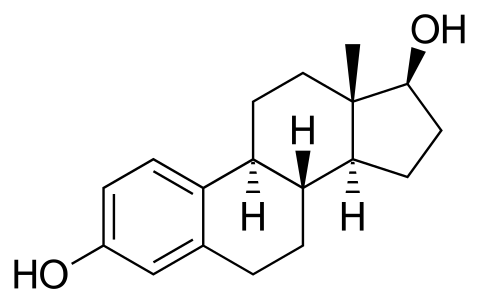
Bioidentical
17β-estradiol (E2)
WHI estrogen
Equilin (CEE representative)
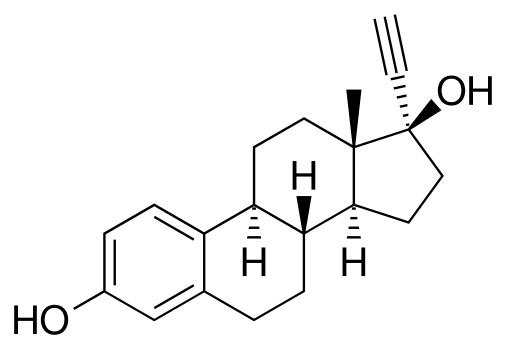
Synthetic
Ethinyl estradiol
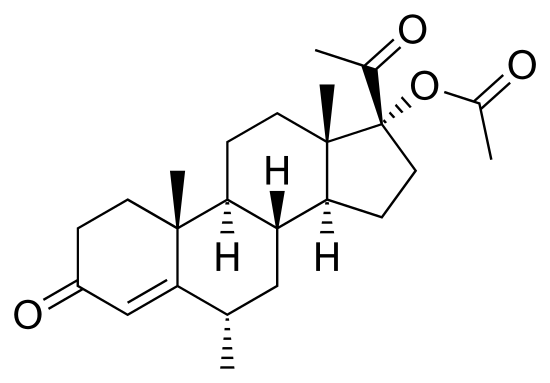
WHI progestin
MPA (Provera)
Image
WHI studied CEE + medroxyprogesterone acetate. Nimbus protocols use estradiol + micronized progesterone — different molecules, different pharmacology, different downstream data.
Credit·Structural SVGs via Wikimedia Commons, public domain (chemical structures ineligible for copyright). Uploaders: NEUROtiker / Vaccinationist / Edgar181.
A bioidentical hormone is structurally identical to a hormone the human body produces — estradiol (E2), progesterone, testosterone, T3, T4, DHEA. A synthetic analog (conjugated equine estrogens, medroxyprogesterone acetate, ethinyl estradiol, levonorgestrel) is not. The pharmacology is different, the receptor binding is different, and — critically — the safety data does not transfer.
The Women's Health Initiative[WHI-2002] studied conjugated equine estrogens (Premarin) + medroxyprogesterone acetate (Provera). Its findings — increased breast cancer, CHD, stroke, VTE — apply to that specific combination. The E3N (EPIC) cohort[E3N-2008] directly compared bioidentical hormone replacement therapy (BHRT) and synthetic regimens in 80,377 French women: estradiol with bioidentical progesterone produced a relative risk of 1.00 for breast cancer; estradiol with synthetic progestins produced relative risks of 1.16–1.69. The route mattered less than the molecule.
Figure
WHI's CEE+MPA result does not transfer to bioidentical regimens. E3N's split between synthetic progestins and micronized progesterone is the key reframe.
Source·WHI 2002 (PMID 12117397); WHI 2004 (PMID 15082697); E3N (PMID 17333341)
Study design before claims — the evidence hierarchy
Interpreting the HRT literature requires holding a discipline most consult notes do not: distinguish association from causation by the design of the trial that produced the number. The hierarchy that anchors every Nimbus claim:
- Randomized controlled trial (RCT) — experimental, can show causation. DOPS, PEPI, HERS, WHI, KEEPS, ELITE, REPLENISH, TRAVERSE.
- Prospective cohort — observational, generates associations. E3N (EPIC), Nurses' Health Study.
- Case-control — observational, narrower scope. CORA.
- Cross-sectional / retrospective chart review — observational, hypothesis-generating only.
Two implications follow. First, the E3N relative risks for bioidentical vs. synthetic progestogen partners are associations from a prospective cohort — strong, biologically plausible, internally consistent across analyses, but not RCT-grade causation. Second, the WHI hazard ratios are causal claims from a randomized trial — but for the specific molecules and specific population studied (mean age 63, median 12 years postmenopause, oral CEE + MPA). Both pieces of evidence are real; neither can be substituted for the other.
Landmark studies — the citation-grade tour
The studies below are the citations every Nimbus modality module quotes. Internalize them in this order. Each gets one paragraph here; the modality modules expand the ones that matter for their domain.
Nurses' Health Study (NHS, 1976). The observational cohort that anchored two
generations of hormone-and-cancer epidemiology. 121,700 female nurses aged 30–55,
mailed questionnaires every 2 years, follow-up extending decades. Found increased breast
cancer, CHD (primarily in smokers), and stroke with oral contraceptives; reduced colon
cancer; and a cardioprotective signal for HRT initiated soon after menopause — relative
risk of death 0.63 for current hormone users vs. never users in the 30–53 estrogen
substudy. The hormones in question were synthetic contraceptives and conjugated
estrogens, not bioidentical E2 + progesterone — a distinction the headlines never
made.[NHS-1976]
PEPI Trial (1997). RCT, 875 healthy postmenopausal women aged 45–64, four hormone
regimens vs. placebo. The CEE-only arm showed higher rates of endometrial hyperplasia;
the bioidentical micronized progesterone arm provided endometrial protection equivalent
to MPA. HRT improved lipid profiles and glucose metabolism, but the trial was not powered
for clinical CV events. PEPI is the trial that established bioidentical progesterone as
endometrially protective in its own right — the foundation Module 02 — Progesterone
builds on.[PEPI-1995]
HERS (1998). Secondary-prevention RCT, 2,763 postmenopausal women aged 44–79 with
established CHD, CEE 0.625 mg + MPA 2.5 mg vs. placebo for ~4.1 years. No overall
CHD-event benefit; early signal of increased CHD events in year 1; reduced events in
years 4–5. HERS concluded that synthetic HRT should not be used for secondary CHD
prevention. The Nimbus reading: HERS is a study of CEE+MPA in women with prevalent
coronary disease — it does not refute the case for early-initiation bioidentical
estradiol in primary prevention.[HERS-1998]
Danish Osteoporosis Prevention Study (DOPS, 2012). 2,016 women aged 45–58, oral
17-beta-estradiol +/- norethisterone, recently postmenopausal at randomization. At
10 years the randomized arm showed significantly lower mortality, heart failure, and
myocardial infarction — with no increase in cancer, VTE, or stroke. DOPS is the cleanest
trial-grade evidence that oral E2-based HRT initiated near menopause reduces hard
cardiovascular endpoints.[DOPS-2012]
WHI — CEE + MPA arm (2002). The trial that drove a generation of HRT
discontinuation. Two-arm RCT, 16,608 postmenopausal women aged 50–79 with intact
uterus, oral CEE 0.625 mg + MPA 2.5 mg vs. placebo. Headline hazard ratios at publication:
CHD 1.29, stroke 1.41, DVT 2.07, PE 2.13, invasive breast cancer 1.26. The trial
was halted early. The 2002 publication emphasized non-statistically-significant findings
to justify early termination, and post-hoc analyses have surfaced baseline risk-factor
imbalance and undisclosed prior-HRT-use distribution between arms. The headline still
shapes FDA labeling and consult-note language. The Nimbus reading: these hazard ratios
apply to CEE+MPA in women a median of 12 years postmenopause — they do not generalize
to bioidentical E2 + micronized progesterone, and they do not generalize to women
initiating near menopause.[WHI-2002]
WHI — estrogen-alone arm (2004). 10,739 postmenopausal women post-hysterectomy,
CEE 0.625 mg vs. placebo, terminated early at 6.8 years for a perceived stroke signal.
Reported hazard ratios: CHD 0.91, breast cancer 0.77, stroke 1.39, hip fracture
0.61. The breast-cancer signal trended down on estrogen alone — a finding routinely
omitted in the public memory of WHI. Post-analysis: decreased breast-cancer and fracture
benefits persisted; the stroke risk attenuated over time. The estrogen-alone arm is the
piece of WHI that, when read on its own terms, supports estrogen replacement in
hysterectomized women.[WHI-CEE-2004]
E3N (EPIC) cohort (2008). French prospective cohort, 80,377 postmenopausal women
aged 40–65, mean follow-up 8.1 years. Breast-cancer relative risks broke down by
progestogen partner: E2 + bioidentical progesterone RR 1.00; E2 + dydrogesterone
roughly RR 1.00; E2 + synthetic progestins RR 1.16–1.69; CEE-alone RR 1.29. Route
of estrogen (oral vs. transdermal) did not change the breast-cancer signal; the
progestogen type did. E3N is the cornerstone study for the bioidentical / synthetic
distinction in Module 01 — Estrogen and Module 02 — Progesterone.[E3N-2008]
KEEPS (2014). RCT, 727 recently menopausal women (≤3 years postmeno) aged 42–58.
Three arms: low-dose oral CEE 0.45 mg/day + cyclic oral progesterone 200 mg
12 days/month, transdermal E2 patch 50 mcg/day + same P4, placebo. No carotid
intima-media thickness difference at 4 years, but oral CEE reduced coronary-artery
calcium accumulation. Both hormone arms reduced vasomotor symptoms and maintained bone
density. KEEPS used CEE rather than bioidentical oral E2 and a 4-year horizon — likely
too short for a full cardiovascular signal — but established the safety of early-meno
initiation.[KEEPS-2014]
ELITE (2016). RCT, 643 postmenopausal women in two strata — early postmenopause
(<6 years) and late postmenopause (≥10 years). 1 mg oral E2 daily + vaginal P4 gel
4% 10 days/cycle vs. placebo, average 5-year follow-up. The early-postmenopause group
showed statistically significant reduction in CIMT progression; the late group did not.
No CAC differences. Oral E2 was safe — no MI or plaque rupture observed. ELITE
operationalizes the "window of opportunity" for atherosclerosis prevention with oral
bioidentical estradiol (see Module 01 — Estrogen for the full window framing).[ELITE-2016]
ELITE-Cog (2016 companion). The cognitive substudy of ELITE separately reported on
verbal memory and executive function in the same 643 women. The headline: oral
estradiol did not impair cognition in either the early or late stratum, and the early
stratum had small numerical advantages on several cognitive measures that did not reach
statistical significance at the 5-year mark. ELITE-Cog is the citation that lets a
Nimbus prescriber defend oral E2 in cognitively concerned patients — it does not show
cognitive benefit in late-postmeno women, but it refutes the claim of cognitive
harm.[ELITE-Cog-2016]
TRAVERSE (2023). RCT, 5,204 men aged 45–80 with clinical hypogonadism plus
symptoms, all with preexisting cardiovascular disease or high CV risk. Testosterone
1.62% gel vs. placebo, ~21 months of treatment, ~33 months of follow-up. The headline:
major adverse cardiovascular event (MACE) incidence was not increased. Higher rates of
pulmonary embolism, atrial fibrillation, nonfatal arrhythmias, and acute kidney injury
were observed but the study was not powered for causality on those secondary events.
TRAVERSE led to the FDA removal of the MACE black-box on testosterone products and is
the foundation of Module 04 — Testosterone in men.[TRAVERSE-2023]
Lab interpretation across vendors
Quest and LabCorp don't always report the same hormone in the same units, and even when the units match, the assay precision and the "normal" ranges differ. Two principles:
- Always know which vendor produced the result you're reading.
- When converting, use the empirical factor — not assumed unit equivalence.
The clearest example: postmenopausal progesterone. Quest's chemiluminescent immunoassay
reads roughly 3.5x higher than LabCorp's assay for the same serum sample. A Nimbus
postmenopausal progesterone target of ≥10 ng/mL on Quest is the same biologic state as
≥3 ng/mL on LabCorp. The conversion is empirical and direction-aware: never assume the
vendors are interchangeable, never report a Quest value against a LabCorp range or vice
versa.
Interactive · Quest ↔ LabCorp converter
Progesterone (postmeno)
Equivalent on quest
10.50 ng/mL
Optimal target · Quest >= 10 · LabCorp >= 3
Bioidentical progesterone. Do not test in pre/peri/PCOS — treat by symptoms.
Analyte
Estradiol — postmenopausal female (pg/mL)
- Quest10–130 pg/mL
Nimbus optimal: 75–100 pg/mL
- LabCorp10–130 pg/mL
Nimbus optimal: 75–100 pg/mL
Figure
Postmenopausal E2 target is unit-equivalent across vendors; the assay platform matters more than the calibration. LC/MS/MS is preferred for low-range serum E2.
Source·Nimbus clinical protocol; vendor reference ranges per academy/docs/source/00-foundations.md §Lab targets
Analyte
Progesterone — postmenopausal female (ng/mL)
- Quest0–20 ng/mL
Nimbus optimal: 10–20 ng/mL
- LabCorp0–6 ng/mL
Nimbus optimal: 3–6 ng/mL
Figure
Quest reads roughly ×3.5 higher than LabCorp for the same serum sample. A Quest ≥10 ng/mL target is the same biologic state as a LabCorp ≥3 ng/mL target — never compare a result against the other vendor's range.
Source·Nimbus clinical protocol §Lab targets — empirical cross-vendor calibration
Analyte
Free testosterone — adult male (pg/mL)
- Quest35–250 pg/mL
Nimbus optimal: 170–210 pg/mL
- LabCorp6–50 pg/mL
Nimbus optimal: 30–40 pg/mL
Figure
Free T in men is the canonical cross-vendor mismatch: Quest's equilibrium dialysis target reads roughly ×5 higher than LabCorp's calculated free T. Module 04 — Testosterone in men expands the platform-specific reasoning.
Source·Nimbus clinical protocol §Lab targets; cross-ref Module 04
The vendor-aware mindset extends to every hormone in the Nimbus curriculum. Free
testosterone in men reads 170–210 pg/mL (Quest) vs. 30–40 pg/mL (LabCorp) at the
same biologic state (see Module 04 — Testosterone in men). Free T3 reference ranges
also differ between vendors and assay platforms (see Module 05 — Thyroid).
Mid-module checkpoint — cross-vendor lab interpretation
Check yourself
A 56-year-old postmenopausal woman on oral E2 + oral micronized progesterone has labs drawn at LabCorp. Her progesterone reads 3.2 ng/mL. The Nimbus postmenopausal P4 target you have memorized is ≥10 ng/mL on Quest. The correct interpretation is:
The universal safety blocks
Hard contraindications gate any HRT initiation at Nimbus. The blocks below are universal across all seven modalities — they sit upstream of any modality-specific dose-laddering. The block, the rationale, and the escalation path are explicit:
- Active prostate cancer. Testosterone replacement is blocked pending oncology clearance. Androgen-driven proliferation is the mechanism; survivorship status and castrate-resistant subtypes require specialist input (see Module 04 — Testosterone in men).
- Active breast cancer. Estrogen replacement is blocked pending oncology clearance. ER/PR status matters; survivorship status matters; the decision is co-managed with the patient's oncology team (see Module 01 — Estrogen).
- Pregnancy or lactation. DHEA is absolutely contraindicated (teratogenic potential). Testosterone is absolutely contraindicated. Estrogen and progesterone are deferred to obstetric management.
- Active immunosuppressant therapy. Melatonin is absolutely contraindicated. Melatonin's immunomodulatory effects make it unsafe in patients on calcineurin inhibitors, mTOR inhibitors, or other transplant-stabilizing regimens (see Module 06 — DHEA / Melatonin).
- PDE5 inhibitor + nitrates or riociguat. Severe hypotension risk — this is a hard block in patient counseling regardless of hormone modality. PDE5 co-prescribing for sexual function (often paired with TRT) requires explicit cardiovascular medication review.
- Hy's Law liver injury (AST/ALT
≥3x ULN+ total bilirubin≥2x ULN). Hold all hormone therapy and escalate urgently to hepatology. The signal indicates serious hepatocellular injury and supersedes any titration decision. - Pituitary adenoma rule-out for low-T men with prolactin
>40 ng/mL. TRT is deferred until pituitary work-up is complete. Prolactin elevation in a hypogonadal man can mask a prolactinoma; initiating TRT before evaluation can confound the diagnostic workup and delay neurosurgical referral (see Module 04 — Testosterone in men).
A secondary block — not absolute but practice-routine at Nimbus — is untreated severe obstructive sleep apnea (STOP-Bang positive). TRT initiation is deferred pending sleep evaluation; testosterone can worsen OSA, and the cardiovascular signal in untreated OSA plus TRT is unfavorable. This is a Nimbus-position block, not a universal contraindication, and is documented as such (see Module 04 — Testosterone in men).
Role-specific applied content
Preview · showing both tracks
For prescribers
Using the Foundations frame to order an HRT initiation workup. The frame is the first three decisions, in order. First, identify the hormone modality the patient needs (estrogen, progesterone, testosterone in women, testosterone in men, thyroid, DHEA, melatonin) and route to the corresponding modality module for the dose ladder. Second, run the universal safety blocks above — every one of the seven — and document explicitly which blocks apply and which are negative. Third, identify the lab vendor your office uses and write the order against the vendor-specific reference ranges and Nimbus optimal targets; do not write an order against a target from the other vendor's calibration.
Charting discipline for initiation. For every initiation, document: which bioidentical molecule (E2, P4, T, T3/T4, DHEA), which route, which target value and which vendor that target attaches to, and which of the seven universal safety blocks are negative. The bioidentical-vs-synthetic call belongs in the consent — patients who have read mainstream coverage of WHI deserve the citation-grade case for the distinction.
Cross-references. Estrogen initiation lives in Module 01 — Estrogen. Progesterone co-prescribing for any patient with a uterus on systemic estrogen lives in Module 02 — Progesterone. Testosterone in women is Module 03; in men, Module 04. Thyroid is Module 05. DHEA / melatonin is Module 06. The cross-cutting clinical practice rules (follow-up cadence, documentation templates, lab-order patterns) live in Module 07 — Clinical practice.
For pharmacists
Using the Foundations frame to review an HRT prescription order. The frame is the same three decisions the prescriber walked, in reverse. First, identify the lab vendor the prescriber wrote against — if the order references a target value, the chart should make explicit which vendor's reference range that target attaches to. Cross-vendor calibration mismatch (a Quest target compared to a LabCorp result, or vice versa) is the most common reversible error in HRT lab interpretation and the most consequential one on dose-titration calls. Second, screen for the seven universal safety blocks before dispensing — even when the prescriber has documented them, a fresh screen catches updates the chart hasn't surfaced (new oncology diagnoses, new immunosuppressant starts, new nitrate prescriptions, pregnancy notifications). Third, confirm the molecule the prescriber ordered matches the bioidentical-by-default policy unless a documented patient-specific rationale calls for a synthetic analog (Premarin, MPA, ethinyl estradiol, levonorgestrel).
Cross-vendor interpretation on counseling calls. When a patient calls with a lab
result, the first question is always "which vendor?" — never assume. The
LabConverter widget above formalizes the most common conversions; for progesterone
specifically, the empirical factor is ~3.5x (Quest reads higher) and the
LabCorp-equivalent of the Quest ≥10 ng/mL target is approximately ≥3 ng/mL (see
Module 02 — Progesterone for the full table).
Compounded vs. commercial. Compounded bioidentical preparations are off-label by default — no FDA-approved compounded product exists. Disclose appropriately, document in the dispense note, and flag any commercial-bioidentical alternative the patient has not been offered.
High-yield facts
Bioidentical vs. synthetic
Different molecules
Bioidentical = E2, P4, T, T3, T4, DHEA. Synthetic = CEE, MPA, ethinyl estradiol, levonorgestrel. Safety data do not transfer.
WHI applies to
CEE + MPA
Specifically: oral CEE 0.625 mg + MPA 2.5 mg in women a median of 12 years postmenopausal. Not E2 + micronized P4.
E3N RR for E2 + bio-P4
1.00
80,377 women, mean 8.1 yr follow-up. E2 + synthetic progestins RR 1.16–1.69; CEE-alone RR 1.29.
Quest → LabCorp P4
~3.5xconversion factor
Quest reads higher; Quest ≥10 ng/mL target ≈ LabCorp ≥3 ng/mL. Cross-vendor calibration mismatch is the top reversible error.
Optimal vs. normal
Treat optimal
Reference ranges describe the average of an unwell US population. Labs guide therapy; symptoms drive decisions.
Universal safety blocks
7 hard blocks
Active prostate / breast cancer, pregnancy / lactation, immunosuppressants + melatonin, PDE5 + nitrates, Hy's Law, prolactin >40 in low-T men.
Pituitary rule-out cut-off
40ng/mL prolactin
Low-T men with prolactin >40 ng/mL: defer TRT pending pituitary evaluation.
Self-check — bioidentical / synthetic
Check yourself
A 70-year-old postmenopausal woman has been on conjugated equine estrogens (CEE) plus medroxyprogesterone acetate (MPA) for 8 years and asks whether bioidentical E2 + micronized progesterone would carry the same risks. The best one-sentence answer is:
Post-test — synthesis
Check yourself
A 58-year-old postmenopausal woman, BMI 27, non-smoker, no VTE history, intact uterus, has labs drawn at LabCorp: estradiol 22 pg/mL, progesterone 0.4 ng/mL. She is symptomatic (nightly hot flashes, sleep disruption). She has no history of breast or endometrial cancer; LFTs are normal; she is not on nitrates or immunosuppressants. The Nimbus initiation plan that integrates molecule, target, route, and the universal safety blocks is: